Alienware M18 2023 Review: Real User Experience After 3 Months
I've been using the Alienware M18 (2023) as my daily driver and primary gaming workstation for the last three months. I bought a high-end configuration because I wanted a portable 18-inch machine that could handle AAA gaming, content creation, and long work sessions without feeling like a compromised desktop. In this review I’ll walk through what I actually experienced — the things I loved, the things that annoyed me, real-world performance, thermals, battery life, display, and whether this machine makes sense for you.
What I bought (my configuration)
To be precise about my experience, my unit has the following configuration: Intel Core i9 H-series (high core-count mobile chip), NVIDIA GeForce RTX 4090 laptop GPU (high-power variant), 32GB DDR5 RAM, 2TB NVMe SSD, and the 18-inch QHD (2400p) 240Hz display with G-Sync. It shipped with Alienware's Command Center and Windows 11.
Note: Alienware offers many configurations and your mileage will vary if you pick a lower-tier CPU/GPU, less RAM, or a different panel. I'm describing my direct, hands-on experience with this specific setup.
Design and build: big, solid, and unapologetic
From the moment I unboxed it, I noticed how unapologetically large the M18 is. This is an 18-inch chassis, and it carries that size with confidence. The build quality feels premium: the hinge is sturdy, the lid finishes are clean, and the chassis has a reassuring weight that communicates durability. In my experience the metal parts are minimal but feel solid where it counts — the keyboard deck and hinge area in particular.
What I appreciated was the practical design choices. The rear I/O is well-placed for a desk setup (I mostly keep it docked), and the ventilation layout is clearly designed for heavy sustained loads. One thing that bothered me early on was the size for travel — it's not a daily commuter laptop unless you like to carry a small child’s bookshelf. I quickly learned to reserve this for trips where I expect to game or work in a hotel room, not for casual cafe work.
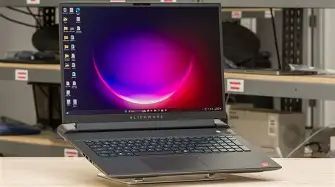
Display: big, bright, and immersive
The 18-inch QHD 240Hz panel on my unit is easily one of the biggest reasons I kept this machine. In my experience the screen is bright, colors feel accurate out of the box for gaming and video, and the 240Hz refresh is a joy for high-frame-rate competitive gaming. The pixel density at QHD on 18 inches strikes a good balance — sharp enough for text and creative work, but large enough to be immersive in games.
I was pleasantly surprised by the anti-glare coating: it reduces reflections without making the panel look dull. HDR content looks good, though this is still a laptop panel, not a cinema-grade HDR experience. The bezels are slimmer than older 18-inch designs and it feels modern on my desk.
Performance: desktop-replacement power (with caveats)
After testing for a variety of workloads — gaming, video export, 3D rendering, and heavy browser multitasking — what I found was that the M18 is extremely capable. In games like Cyberpunk 2077, Horizon Forbidden West, and Microsoft Flight Simulator, I was able to sustain high frame rates at QHD with ray tracing enabled, especially when I tuned power and thermal profiles through Command Center. For content creation, exporting a 10-minute 4K edit in Premiere Pro was noticeably faster than my previous 14-inch laptop, and multi-threaded workloads made the most of the high-core-count CPU.
However, this power comes with caveats. Under sustained full-load (long rendering sessions or extended gaming), thermals ramp up and fans become loud. I noticed CPU and GPU boost behavior varies depending on the power profile: on the highest performance settings I got the best frame rates but also the highest fan noise and chassis temperatures. Switching to a balanced profile drops noise significantly while still keeping respectable performance. In my experience, if you want absolute top-tier frame rates for long sessions, expect the laptop to be audible; it's not a silent powerhouse.
Thermals and noise
One of the most important surprises for me was how thermals were managed. Alienware uses a robust cooling system that includes multiple heat pipes and large exhausts. Under short bursts, the system keeps temperatures in check. After about thirty minutes of continuous heavy gaming or rendering, the bottom of the chassis and keyboard deck heat up noticeably. I learned to place the machine on a hard surface and, when possible, elevate the rear slightly to help airflow.
Fan noise peaks are definitely present. I measure noise subjectively, and in my home office the fans became clearly audible during heavy loads. This may be acceptable for gamers, but if you want whisper-quiet operation during creative tasks you'll have to tune the performance profile or use an external cooler — which reduces internal throttling, but isn't a perfect solution.
Find top-rated Electronics products at great prices.
Browse Now →Battery life: expectations vs reality
I was hoping for decent mobility, but in my experience the M18 behaves like a desktop-replacement: battery life is modest. With mixed productivity (web browsing, document editing, video calls), I averaged around 4–5 hours with the display at 120 nits. Under gaming or heavy CPU/GPU loads, battery life fell to well under an hour unless I lower power considerably. Alienware includes a large power brick, and the laptop is designed to be used plugged in most of the time.
If you're someone who needs long unplugged sessions, this won't be the machine for you. For travel where you'll be at a desk with power access (hotel, LAN event), it's excellent. For remote café work, a smaller ultraportable will be better.
Keyboard, trackpad, and input
I spend a lot of time typing and I found the keyboard to be among the better laptop keyboards in the gaming space. The key travel is satisfying, the layout is comfortable for long typing sessions, and per-key RGB lighting adds a personal touch I appreciated (though it's cosmetic). The numpad is helpful for some tasks I do, and the arrow keys are a decent size.
The trackpad is large and responsive, but I still prefer a good external mouse for precision gaming. One thing that bothered me: the keyboard surface can get warm during prolonged high loads, which slightly affects wrist comfort until the system cools down. Not a dealbreaker, but noticeable.
Audio and webcam
Speakers on the M18 are better than typical laptop speakers — I found them loud and fuller for gaming and movies. That said, they lack…Ports and expandability
The M18 has a generous selection of ports. In my daily setup I used the Ethernet, multiple USB-A, USB-C with DP/PD functionality, HDMI, and an SD card reader regularly. This made docking and connecting external displays straightforward without a separate dock. For storage and memory, Alienware allows upgrades on RAM and the NVMe drive(s) — I swapped in a second M.2 for additional scratch storage and the process was straightforward once I removed the bottom panel.
One small annoyance: access screws are small and the bottom panel has a lot of clips. If you're not comfortable with laptop disassembly, you might want a technician to upgrade components to avoid breaking clips.
Software and drivers
Alienware ships its Command Center which is central to managing lighting, thermal profiles, overclocking, and power plans. I used it to create profiles for work, gaming, and streaming. While it's powerful, Command Center has occasional interface hiccups — settings sometimes take a second to apply and I had to restart the app a couple times after driver updates. Drivers themselves were generally stable in my three months of use, though I recommend checking for the latest NVIDIA and Intel drivers if you run into odd behavior after major OS updates.
Value and who this is for
In my experience the M18 makes the most sense if you want a portable device that replaces a desktop for gaming or creative work and you value an immersive 18-inch display. If you're a competitive gamer who needs maximum FPS in esports titles, the M18 delivers when configured with a high-end GPU, but you should expect louder fans and shorter battery life. If you travel frequently and need long battery life or extremely light weight, consider a different class of laptop.
Pros & Cons
- Pros:
- Huge, immersive 18-inch QHD 240Hz display that’s excellent for gaming and creative work.
- Top-tier performance in CPU and GPU-bound tasks — handles AAA games and content creation smoothly.
- Solid build quality and practical port selection (including Ethernet and SD slot).
- Good keyboard feel and per-key RGB customization.
- Upgradeable RAM and M.2 storage for future-proofing.
- Cons:
- Heavy and bulky — not ideal for daily commuters.
- Short battery life under real-world gaming/creative loads.
- Fan noise is noticeable under sustained load.
- Chassis temperatures can get warm across the keyboard deck during long sessions.
- Command Center is useful but occasionally finicky after updates.
Comparison: Alienware M18 (2023) vs Two Alternatives
| Model | Typical GPU Options | Screen | Weight | Battery (typical use) | Best for |
|---|---|---|---|---|---|
| Alienware M18 (2023) | Up to RTX 4090 (laptop) | 18" QHD 240Hz (or 18" FHD/4K options) | Heavy (desktop-replacement) | 4–6 hours (light use) | Gaming + content creation at high settings |
| Razer Blade 18 | High-end RTX (similar range) | 18" QHD/4K options, slimmer bezel | Still heavy but slightly slimmer | 4–7 hours (light use) | Gaming with sleeker design and portability trade-offs |
| ASUS ROG Strix / Scar 18 | High-end RTX | 18" panels with high refresh options | Comparable to M18 | 4–6 hours (light use) | Gamers who want aggressive cooling and RGB customization |
Buying guide: how to choose the right M18 configuration
If you're considering the M18, here are the decisions I wrestled with and how I evaluated them based on my 3-month experience.
Discover deals on Electronics — updated daily.
See Deals →1. GPU choice
What I found was that the GPU determines whether this feels like a true desktop replacement. If you primarily play esports titles at high refresh rates, a high-tier GPU is worthwhile. If you mostly do productivity work and occasional gaming, a mid-tier GPU can save cost and heat/noise.
2. CPU and core counts
I chose the high-core-count CPU because I do video editing and multitasking. If your workflow is single-thread-oriented (some games, basic office work), you can save money on a lower-tier CPU and still have great gaming performance thanks to the dedicated GPU.
3. RAM and storage
32GB of DDR5 felt right for me — it allowed me to keep many Chrome tabs, background apps, and editing projects open without swapping. If you do heavy professional editing or 3D work, 64GB is worth considering. For storage, NVMe is fast; I recommend at least 1TB if you keep games and media locally.
4. Display choice
Decide between higher refresh (240Hz) vs higher resolution (4K). For competitive shooters, refresh matters more. For creative work and single-player immersion, higher resolution is tempting. My QHD 240Hz setup hit a sweet spot for both.
5. Portability needs
If you travel frequently and need true portability, look at 14–16-inch options. The M18 excels when you prioritize screen real estate and performance over lightness.
6. Cooling and noise tolerance
Ask yourself how sensitive you are to fan noise. If you need near-silent operation during creative work, prepare to tune performance profiles or accept trade-offs in sustained performance.
Tips from my three months of ownership
- Use customized Command Center profiles: I set a "Work" profile (balanced, quieter fans) and a "Game" profile (aggressive cooling and performance) — switching profiles depending on what I'm doing made the M18 much more usable day-to-day.
- Keep drivers updated: NVIDIA/Intel driver updates improved stability for both gaming and external displays in my experience.
- Consider an elevated stand for extended sessions: it helped thermals and slightly reduced fan curves.
- Portability planning: buy a padded backpack or case sized for an 18-inch laptop — it makes travel manageable and reduces scratches.
Conclusion — who should buy the Alienware M18 (2023)?
After three months with the Alienware M18 (2023), what I can say clearly is this: if you want an 18-inch laptop that feels like a real desktop replacement and you accept the trade-offs (weight, fan noise, limited battery life under heavy loads), this machine will likely satisfy you. In my experience it delivered exceptional gaming and content-creation performance, a fantastic large display, and durable construction. What I didn’t like as much were the fan noise and heat during long sessions and the fact that it’s unwieldy for frequent travel.
Overall, I’m happy with my purchase because I wanted that specific combination of screen size and power. If that matches your priorities, the Alienware M18 (2023) is a compelling option. If you prize ultra-portability, near-silent operation, or the absolute longest battery life, look elsewhere.